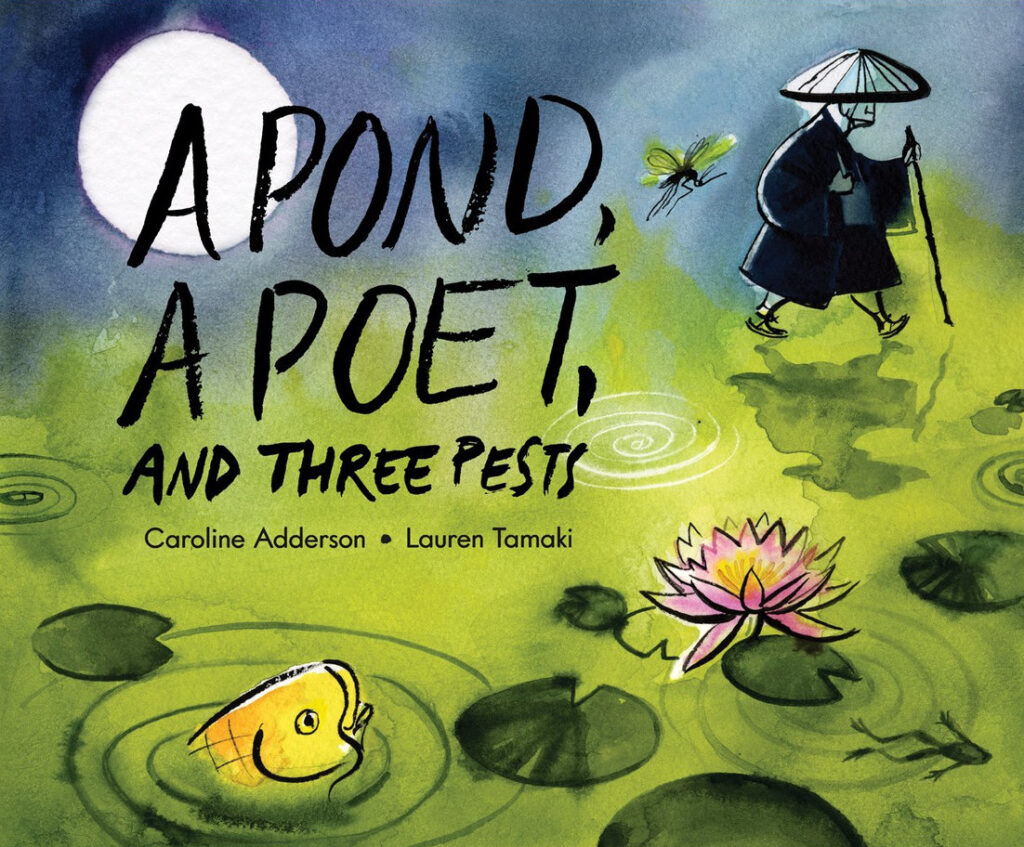
A funny new fable about artistic creation and chasing fame inspired by one of Japan’s most famous haikus, “The Old Pond.”
Bashō, a 17th-century poet on an evening walk, stops to rest next to a murky old pond. Here, readers may expect he will encounter the frog that inspired his renowned poem:
Old pond—
Frog jumps in
Splash!
But before the frog came the mosquito, who smells blood: “My life?” it whines, “It could fill a book of poetry!” And before the mosquito came the lily, who perfumes the air, hoping to be immortalized in a poem. And before the lily came the carp, who flutters its tail in the poet’s face.
In a twist that would have delighted Bashō, a Zen Buddhist, the fame-seeking creatures cause only their own suffering. Instead, the inspiration for Bashō’s poem comes from a frog that only wants a morning swim. Splash!
Buy A Pond, a Poet, and Three Pests at Amazon.ca or find a local bookstore.
Publishers’ link: Groundwood Books
- Nominated for the 2026 Sheila Barry Best Canadian Picture Book Award
- Nominated for the 2026 Canadian Children’s Book Centre’s David Booth Children’s Poetry Award
- A Historical Novel Society Editor’s Pick
- The BC Review Reviewer’s Pick
- A Let’s Talk Picture Books Favourite Picture Book of 2025
- A TD Summer Reading Club 2026 Selection
- A Horn Book Poetry Month Selection
Praise for A Pond, a Poet, and Three Pests
“Full of low-key humor and beauty, this is a wonderful book about contemplation, ego and the happy accidents of creativity.”
“What makes this book unforgettable is its gentle reminder: greatness often arrives when we stop chasing it. The frog doesn’t perform, plead, or posture—it simply lives. And in that moment of authenticity, Bashō finds his muse. In a world of curated perfection and performative brilliance, A Pond, A Poet, and Three Pests offers a splash of clarity. It’s a story that teaches children (and reminds adults) that sometimes, the most poetic thing we can do… is just be.”
“This multilayered picture book offers a whimsical interpretation of the famous haiku “Old Pond” by the master poet Matsuo Bashō (1644-1694) and celebrates nature and poetry with thoughtfulness and irony.”
—The Horn Book
“This book is an artistic imagining of how a famous poet wrote one of his most famous haikus. In simple, but far from simple text, there is an actually in depth story about the Japanese poet in the style of a folktale and not only includes the poem’s potential beginnings, but also is a mini biography of sorts. The poem, “The Old Pond” by Basho has calming text as we follow the animals trying to grab the attention of the poet, as he rests by the side of a pond. Each of the “pests” try to be flashy, wanting attention, but it is the frog that is rewarded. What does that mean? Well, to me, that is the point. Like poetry itself, there is a bit of interpretation left up to the reader… It is an experience book that from the text to the artwork, everyone will experience in their own way, but hopefully it will be a calming, but amusing, experience.”
—Cannonball Read
“Before [the frog’s] splash echoes through literary history, a cast of self-important characters—a mosquito, a lily and a carp—compete for the poet’s attention. Their craving for recognition leads only to disappointment, while the frog, uninterested in fame, simply jumps. Adderson’s playful fable offers a meditation on art, ego and the accidental nature of inspiration.”
“Adderson and Tamaki imagine a playful encounter between Japanese poet Matsuo Bashō and three would-be muses vying for placement in his work… [S]pare lines humorously explore the pursuit of celebrity and continuation, while watercolor illustrations blend a limited palette of gold, indigo, olive, and pink, conjuring fluid-feeling visuals that juxtapose movement and stillness.”
“Inspired by one of Japan’s famous haikus, “The Old Pond,” this picture book follows the noted poet Bashō as he sits down by the pond, closes his eyes, and thinks quietly in solitude… Evocative descriptions and lyrical alliteration evoke the peaceful night ambiance at the pond while acrylic ink brushwork techniques blend well with diluting textures of midnight blues and mossy greens, adding depth to Bashō’s moment of stillness. Shifting perspectives and curving linework create a rippling effect that brings a sense of dreaminess and intrigue to the double-page spreads.”
—Bulletin of the Center for Children’s Books
“Adderson’s succinct text is a clever reflection of Bashō and his precise verses. Tamaki presents her visceral illustrations in saturated swathes of blues and greens with pleasingly popping yellows and pinks. Multiple close-ups of uninterruptible Bashō brilliantly ensures that his wide-eyed, rainbow-energy-emitting final portrait is a humorous, affecting delight… A gleefully inventive tale that captures the provenance of one of history’s most famous poems.”
“In this original episode, the poet Bashō sits down next to a pond, closes his eyes, and takes nn apparent notice as a golden carp, a graceful water lily, and a whining mosquito all insistently beg for his attention: “O, Bashō! Big fan. My life? It could fill a book of poetry!” Using brushed ink on wet paper to create atmospheric moonlit scenes, Tamaki depicts a poet at work, sitting quietly, seemingly oblivious to distractions, and responding at last not to the elegant fish, the lovely flower, or the long-legged insect diva but to the plain frog who takes a flying leap into the pond and inspires the most famous haiku ever: “Old pond— / Frog jumps in. / Splash!” In an afterword that includes an analysis, transliteration, and direct translation of the poem as well as comments about the poet and the poetic form, Adderson invites readers to do as Bashō did: go outside themselves, close their eyes, and then express in three lines and as few words as possible what they perceive most intensely.”
—Booklist
“Gorgeous minimalist watercolor illustrations with calligraphy-line accents complement this cheeky fable about haikuist Matsuo Bashō’s inspiring evening by a pond. When he sits on the bank to rest and think, a school of carp are starstruck. Desperate to take center stage in his next poem, they begin showing off. A waterlily who wants to be immortalized soon joins in their pageantry, as does a mosquito who’s a “big fan” of the poet’s lines. Ultimately, a more unassuming creature turns the writer’s head.”
“Adderson and Tamaki capture the serenity of a Japanese garden, a quiet poet and others’ need for fame… This is an excellent book to include in units on teaching poetry.”
—School Library Journal
“Caroline Adderson gives us a big story for a very simple poem and reminds all those who are Look-At-Me people—you know the ones that always demand attention and recognition—that fame doesn’t have to come from the ego but rather from the lack thereof. The natural beauty of that frog just going about its business is far more notable than the extreme actions of some other self-absorbed organisms.”
“The book beautifully captures this truth: thoughts and sensations arise like visitors at the pond — colourful, noisy, or fragrant — and then, just as naturally, they fade away. Bashō does not struggle to shape them into a poem; he simply sits and watches them come and go, serene and present. In its own playful way, this delightful book invites us to do the same.”
“This is a brilliantly conceived picture book. The text on each page is simple. The full-page, gorgeous illustrations, in watery green and blue, clearly show the actions and desires of the pests… and the stillness of the poet. The splash of the frog and the famous haiku are a wonderful finish. End pages explain more about haiku and the poet, and encourage readers to write their own nature haikus. A beautiful, magical book. The publisher recommends ages 3-6, but I recommend it for older children too.”
“[A] lively and amusing picture book, A Pond, a Poet, and Three Pests, is a marvel in miniature, with an educative intent that’s stimulating and funny while also thoughtful and illustrative.”
“Simple yet thought-provoking, haiku is often one of the first types of poetry that young children learn—and this charming story introduces them to the beauty behind the form. As the 17th-century Japanese poet Basho meditates beside a pond, a carp, a lily, and a mosquito each try vying for his attention, hoping to become the subject of his next haiku. But, eventually, it is a wayward frog that ends up inspiring one of his most famous poems, ‘The Old Pond’.”
—Tricycle
“A Pond, a Poet, and Three Pests”…is ancient poetry with a timely way in our narcissistic world. With our leaping for attention or selfie-centre, this is a bow to taking the nearest exit from the madness.”
—The BC Review (Reviewer’s Pick)
“Adderson beautifully captures the spirit of an old legend or fable, using flowery adjectives and simple sentence structures. The story is short and straightforward, accompanied by various opportunities for onomatopoeia, which will make for a fun read-aloud.”
“A lot of kids books about poetry are forced, or celebrate poetry without really being poetic. However, Caroline Adderson’s 2025 picture book is more successful due to its focus and structure. It focuses on the Japanese haiku master Basho, and uses a structure that blends appropriate temptations/irritations for a poet with the repeating challenges of fairy tales. A carp, a lily, and a mosquito all visit Basho while he sits. (The book says he’s thinking, but his posture is closer to a classic meditation seating.) All try to distract him or claim center stage in his mind (and poetry); all fail.Then a frog jumps, and in its splash generates Basho’s classic haiku, thus modeling both Western inspiration and the Zen moment of satori.”
“[A] gem of a picture book. Skillfully written with different poetic tools—alliteration, a little touch of rhyme and carefully crafted haikus… It’s a great picture book to use with students of all ages.”
“In this beautifully-crafted picture book inspired by Matsuo Bashō’s “The Old Pond,” as the poet meditates at a pond, a carp, a lily, and a mosquito in turn try to attract his attention. However, it is a frog whose decision not to let the “three pests” and the pensive poet stop his midnight swim leads to his being immortalized in a poem.”
—Children’s Literature and Reading Special Interest Group
“…a beautifully illustrated tale of creativity and personality stimulated by nature.”